

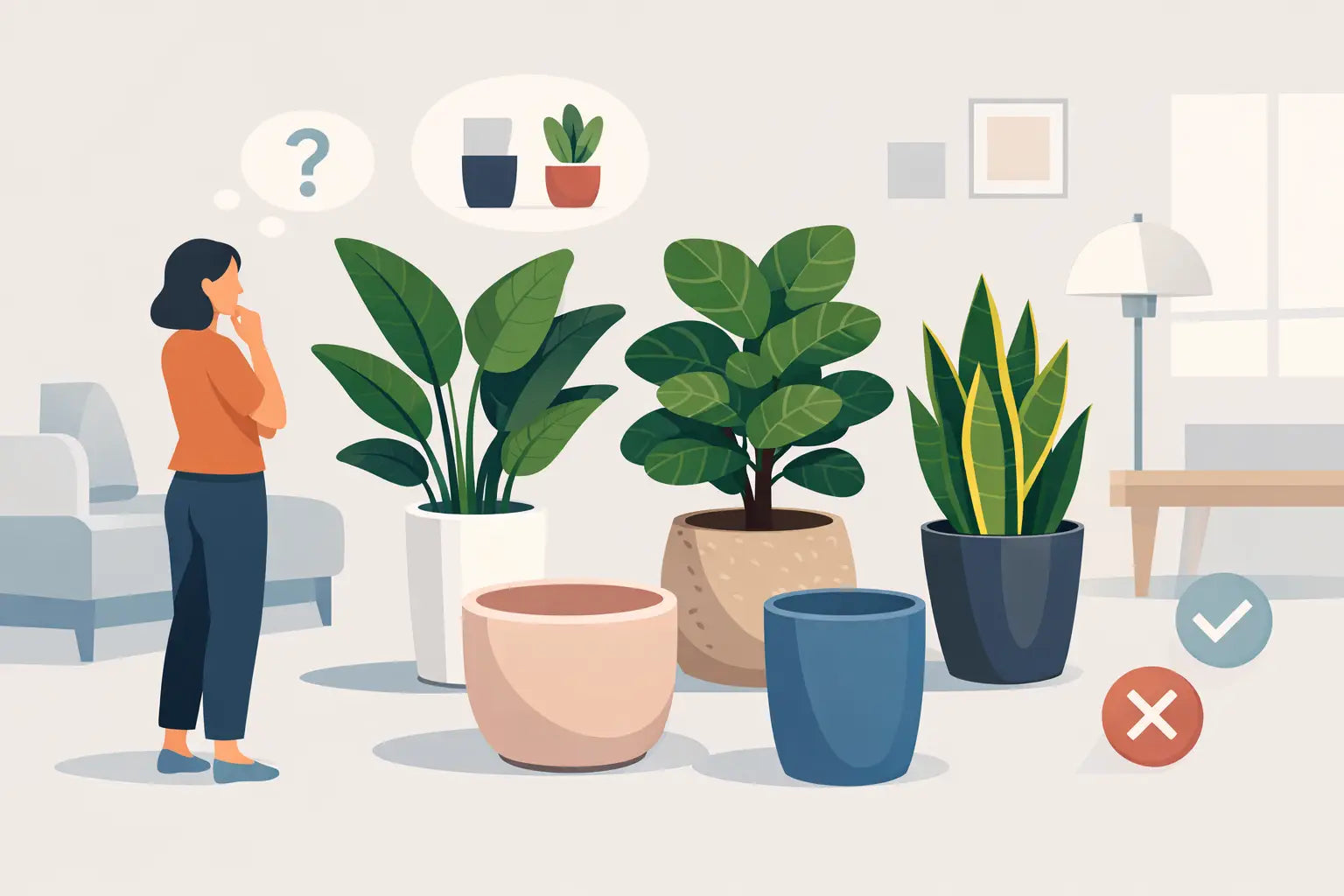
Choosing a large indoor plant pot without making mistakes
A large indoor planter is one of those items that instantly changes the entire vibe of a room. Not subtle, not shy – just immediate added ambiance, height, and personality. But that’s precisely why it often goes wrong: the pot is too small for the plant, too heavy for the spot, or just not exciting enough for the rest of your interior.
Why a large indoor planter makes such a difference
Small accessories are nice, but a large pot makes a real statement. It fills an empty corner, brings balance to a room with many clean lines, and finally gives a plant the stage it deserves. This works particularly well in living rooms, hallways, and home offices. You immediately get a styled look without having to place ten individual items.
There's also a practical advantage. Larger pots appear calmer than a collection of small pots at different heights. Less cluttered, more impact. That’s exactly why a large indoor planter is so popular with people who want to see quick results in their interior design.
Don't start with the pot, but with the place
This is the most common mistake. You see a beautiful pot, fall in love, mentally pay for it, and only then does the question arise: where should it actually go? It's smarter to do it the other way around.
First, look at the space. Will the pot be in a narrow corner, next to a sofa, in the hallway, or prominently displayed? In a walkway, you don't want an extremely wide shape that makes the passage awkward. In a large living room, you can certainly go for volume; otherwise, the pot will disappear against furniture and wall decor.
Also pay attention to what is already there. If you have many round shapes, such as an organic coffee table or soft armchairs, a sleek tall pot often works as a beautiful counterbalance. If your interior is rather minimalist and clean, a more playful shape or striking color can loosen things up.
The right size will feel naturally logical
A large pot should be present, but not clumsy. As a rule of thumb: a pot should be proportionate to both the plant and the space. A large room will swallow a medium pot without a second thought. A compact bedroom, on the other hand, can quickly feel crowded if you choose something too massive.
If you're torn between two sizes, bigger is often more exciting – provided the spot can handle it. A statement item shouldn't look like it's apologizing.
Which shape suits your interior?
The shape matters more than many people think. A tall, narrow pot draws the eye upward and is ideal if you want to add height without sacrificing much floor space. Handy in a corner next to a cabinet or curtain arrangement.
A low, wide pot feels calmer and more grounded. This works well with full plants with broad leaves or as a counterpoint to tall furniture. Round pots appear softer and friendlier. Sleek cylindrical shapes give a more modern, gallery-like appearance.
There is no universally best choice, as it depends on the effect you are looking for. Do you want a pot that blends in with the rest, or one that steals the show? Both are possible, but choose consciously. A large indoor planter is not background decoration. It participates.
Material: beautiful is not enough
With a large pot, the material counts extra heavily, both literally and visually. Ceramic often has a luxurious appearance and feels rich in color and sheen. The disadvantage is clear: it can be heavy and fragile. Handy if you place it once correctly, less handy if you like to keep moving things around.
Metal looks robust, modern, and sometimes a bit hotel chic. However, it can quickly feel cold in a room that otherwise has many soft textures. Plastic is lighter and practical, but it needs to look good. With a large pot, cheap material is more noticeable in the finish.
Composite or fiber clay strikes a nice balance between looks and practicality. It often has that more luxurious appearance without immediately causing a hernia when moving it. Especially for a large indoor planter, this is a smart middle ground.
Weight is not a detail
A pot on the ground floor is different from a pot you have to carry up three flights of stairs. And you don't want to be surprised on parquet, a rug, or a delicate floor either. So check beforehand if the pot is still practical once it has soil and a plant in it. Big and glamorous is nice, but you also want to be able to rotate it if the light changes.
Choosing color without playing it safe
Neutral tones always work well. Sand, beige, black, off-white, and taupe provide calm and let the plant speak for itself. Especially if you like a clean interior, you're safe with these. But "safe" isn't always the most exciting word in home decor.
A large pot is also the perfect opportunity to add color. Deep green, terracotta, glossy burgundy, or a soft pastel can instantly give a room more character. Especially if the rest of your base is calm, this works surprisingly well.
If you want the pot to truly become part of your styling, then carry over a color from a cushion, poster, or vase. That way, it doesn't feel random, but deliberate. This gives even a striking item a sense of calm.
The match with your plant makes or breaks the whole
A pot can be ever so beautiful, but if the plant and the shape work against each other, the whole thing looks messy. A tall sansevieria or olive tree often does well in a slender model. A full monstera or large fern usually requires more width and visual foundation.
Also consider growth space. You don't immediately need to choose an excessively large pot, but a tiny rim around the grow pot often looks meager. There should be some breathing room. That makes the styling richer and calmer.
If you use an inner pot inside a decorative pot, make sure the proportions are correct. Too deep or too shallow can make your plant disappear or stand awkwardly high. Sometimes a simple riser on the inside is enough to solve that.
Styling: how to really make a large indoor planter work
The power of a large pot often lies in simplicity. You don't need to put five accessories around it to make an impact. In fact, that draws attention away from the statement.
Give the pot space. Next to a sofa, at the end of a sideboard, in an empty corner with daylight, or as a solo item in a spacious hallway – that's where it truly shines. If you place multiple large items in one zone, pay attention to height differences and material. Otherwise, you'll get a showroom feel instead of a homey one.
A striking pot can certainly have a bit of attitude. This also fits well with a brand like Housevitamin, where home accessories don't meekly sit in a corner but genuinely want to be seen.
Where should you preferably not put it?
Right next to a frequently opening door is asking for trouble. In the middle of a busy walkway too. And directly against a radiator is not a dream spot for many plants. Good styling only truly works if it remains livable.
Common mistakes with a large pot
Choosing too small is the classic. People are afraid that large is too overwhelming, while the end result often looks puny. A second mistake is only looking at the pot and not at the total combination with the plant, floor, and furniture.
Gloss and texture are also underestimated. A matte pot can be chic and calm, while a glossy finish adds more punch. Neither is better, but it must suit the rest of your interior. If you already have a lot of gloss from mirrors, metal, and glass, then matte can bring balance.
And then there's this: don't underestimate maintenance. A light pot shows dust and stains more quickly. A pot with a lot of relief is beautiful, but sometimes less convenient if you want something you can quickly clean.
When is more expensive really better?
Not always. A higher price can be due to material, finish, craftsmanship, or a unique design. This is often reflected in appearance and lifespan. But there are also affordable pots that look surprisingly good, especially if the shape is strong and the color is right.