Styling vases without flowers? Here's how
A vase without flowers is not an empty space. It's a styling opportunity with attitude. Styling vases without flowers gives your interior an airy, unique, and slightly more exciting feel than the standard bouquet of tulips on the table.
The great thing is that you don't need a large budget, a florist, or a perfectly styled designer home for this. A good vase already does a lot of the work itself. The rest lies in how you combine it, where you place it, and how much boldness you dare to add. Think less about function and more about ambiance. Then a vase suddenly becomes an object, an accent, and sometimes even the star of the room.
Why styling vases without flowers works so well
Flowers are beautiful, but also temporary. They require maintenance, don't always fit the season, and can quickly make a styling predictable. A vase without flowers, on the other hand, remains calm, sculptural, and easy to combine with the rest of your interior.
This works especially well if you like a tidy look with character. A striking shape, glossy finish, or playful color can be enough to add more tension to a shelf, coffee table, or dresser. You don't need any extra filling to make an impact.
There is a difference between intentionally empty and simply forgotten. A vase without flowers should look like it's there for a reason. You achieve this with scale, material, and the styling around it.
Start with the vase itself
Not every vase needs to be filled. Some vases are bought precisely for their silhouette. Think of organic shapes, ridges, handles, glossy finishes, or matte ceramics with an artistic appeal. If the form is strong enough, empty is absolutely no problem.
Therefore, first look honestly at the vase. Is it a basic glass model that is primarily functional, or a decorative item with presence? A simple cylindrical vase can look bare when standing alone, but becomes interesting in a group. A striking designer vase, on the other hand, can shine perfectly on its own.
Size also plays a role. A small vase on a large dining table quickly disappears. An oversized vase on a narrow shelf feels too heavy. It's all about proportion. If that's right, even an empty vase looks deliberate and stylish.
Styling vases without flowers on a table, cabinet, or shelf
The location determines the approach. On a dining table, you usually want something that creates atmosphere without blocking the view. Lower vases or a duo of different heights work well there. On a dresser, it can be more exciting. There you can go higher, play with asymmetry, and let the vase interact with candlesticks, books, or a mirror behind it.
On an open wall shelf, balance is extra important. Don't place a vase exactly in the middle, unless you're going for a sleek, symmetrical look. It often looks stronger if you place it slightly off-center, with a small object or a stack of coffee table books next to it. This creates a corner with rhythm instead of loose items next to each other.
In the bathroom, a vase without flowers works surprisingly chic. Especially in combination with hand soap, a scented candle, or a small dish. It immediately makes the space less functional and more like a boutique hotel.
What you can put in a vase if you still want something
Without flowers doesn't mean a vase always has to remain empty. Sometimes a model asks for a little height or texture. Then there are plenty of options that last longer and are at least as decorative.
Dried branches are a classic, but choose them consciously. A few gnarled branches add character, while an overly full bundle quickly becomes dusty or old-fashioned. Decorative branches of metal, wood, or artificial material can also work well if you're going for a modern look.
You can also think of pampas, dried leaves, sculptural stems, or even nothing natural at all. A vase with loose decorative beads, a rolled-up poster, wooden sticks, or a string of lights can turn out surprisingly well, depending on the space. It depends on the style of your home. Clean and minimal calls for calm. Colorful and eclectic can handle more.
Work with groups, not with random individual items
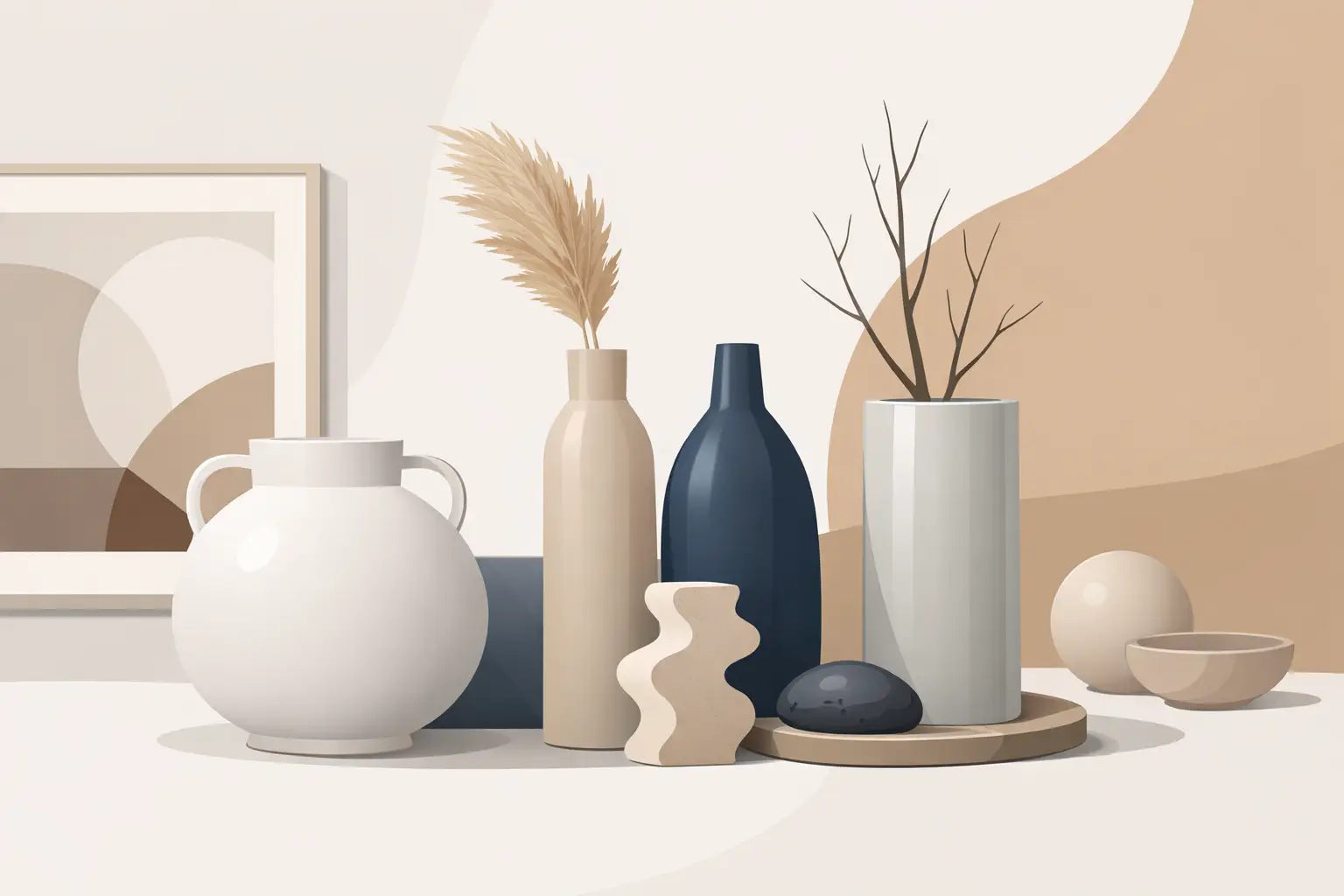
A vase rarely stands strongest on its own. Especially if it doesn't contain flowers, it helps to make it part of a small styling story. For example, combine a vase with a candle holder and a low dish. Or place three vases together in different shapes, but in colors that complement each other.
The trick is variety with coherence. Mix high and low, round and sleek, gloss and matte. But maintain a common thread somewhere, such as material, color tone, or design language. Otherwise, it becomes messy instead of playful.
If you want to keep it easy, opt for tonal styling. Think of sand, cream, smoke glass, or warm brown in one setting. Prefer more pizzazz? Place a vibrant vase against calm basics. Then that one item gets all the attention it deserves.
The rule of odd numbers
Three objects together often look more natural than two or four. That comes across as less stiff. A vase, a candle holder, and a small ornament quickly form a nice trio.
But here too, the rule applies - look at the surface. On a narrow side table, three is sometimes too much. On a wide cabinet wall, one object can look lost. Styling is not mathematics, but intuition with a bit of strategy.
Material makes the difference
Ceramics feel warm and earthy. Glass looks fresher and lighter. Metal adds an edge. And a vase made of colored resin or with a glossy finish immediately attracts the spotlight. When working without flowers, you see material even better. This means that texture becomes extra important.
In a calm interior, matte and natural materials are often beautiful because they subtly add depth. In a cheerful or more outspoken space, it can shine, glitter, or have an unusual shape. That's where that playful home vibe that Housevitamin fans love truly comes to life.
Also pay attention to the season. In autumn, smoke glass, dark ceramics, and deep shades feel logical. In spring, you might prefer transparent glass, soft colors, or a vase with an airy shape. You don't have to replace everything all the time, but a small switch in material or color can do a lot.
Large vases versus small vases
A large floor vase without flowers can look fantastic, but only if it has enough body. A flimsy, too light model quickly looks like something is missing. For large vases, therefore, choose a pronounced shape, texture, or color. Then it stands on its own as a decorative piece.
Small vases are easier, but also run the risk of appearing useless more quickly. Therefore, it's better to group them than to place them solo. A set of small vases on a tray, nightstand, or windowsill immediately looks purposeful.
If you combine multiple sizes, you automatically create depth. This makes a styling corner richer without having to be cluttered.
Common mistake when styling vases without flowers
The biggest mistake is being too cautious. Then there is one well-behaved vase on a much too large surface, and nothing else happens. That doesn't look minimalistic, but unfinished.
The second mistake is the opposite - too much small decoration around it. Then the vase loses all its power. Give it space, but not lonely amounts of space. You see that difference immediately.
Also important: look at the background. A vase in front of busy patterned wallpaper needs less than a vase against a white wall. Contrasts help. A light vase on a light surface can be beautiful, but then needs texture or shape not to disappear.
This is how every space gets more personality
A vase without flowers is secretly one of the easiest ways to quickly give your interior more character. You can soften an empty corner with it, style a cabinet to be more exciting, or give a table that extra layer of atmosphere without much effort.
And perhaps that's the best part. You don't have to wait for fresh flowers, a special moment, or a complete makeover. Sometimes one good vase, in the right place, is enough to lift the entire vibe of a room.
So don't just see a vase as something that needs to contain something. See it as something that already says something in itself.